The Map Itself
Why AI is so much bigger than large language models, and what lives in the regions nobody's talking about right now.
Ayşin Sancı / 12 August 2026
All that's left to learn is OCR
A while ago I was working on an integration team, maintaining 5+ development tools supporting 15+ development teams, while doing my master's at Boğaziçi. I was good at it. I'll be honest, I was in a bit of a hero complex about it, and, to be fair to past me, the work was genuinely going well. I had data mining under my belt from the master's, I understood systems, I could ship. It felt like I could see most of the field, and only a little was left to learn.
Then I read an article that quietly cracked that open: A Poet Does TensorFlow. I wasn't even thinking "this is AI." I was thinking: wait, machines can understand images? And it set my mind running. How does a machine actually see a photograph, read a number plate off a car, recognise a face, the things I did without thinking? I figured that was the one grain of sand left on the beach. Learn how machines read an image, a bit of OCR, and I'd have the full picture.
So I started digging. And the grain of sand turned out to be an ocean. Then I looked up and saw it wasn't one ocean, it was many, each one enormous, each one with its own coastline I'd never even heard of. What I'd thought was almost the end of my learning was barely the shoreline.
So what had I fallen into?
What I'd stumbled on has a boringly human definition underneath it. Intelligence, ours, is a loop. We perceive the world: we see, we hear, we read. Then we process what we took in. Finally, using that processed information, we act toward some goal. Artificial intelligence is the attempt to build machines that run the same loop, that perceive, process, and act on tasks we'd normally say require a human mind.
And once you see AI as that loop rather than as a product, it stops looking like one shiny thing and starts looking like what it is: a wide territory, with different regions for different parts of the loop. My number-plate question wasn't the last thing to learn. It was one doorway into one region.
The regions I'd missed
Here's what that number-plate question actually opened up. Three big regions, and inside each one, a set of distinct capabilities you already use without thinking about them.
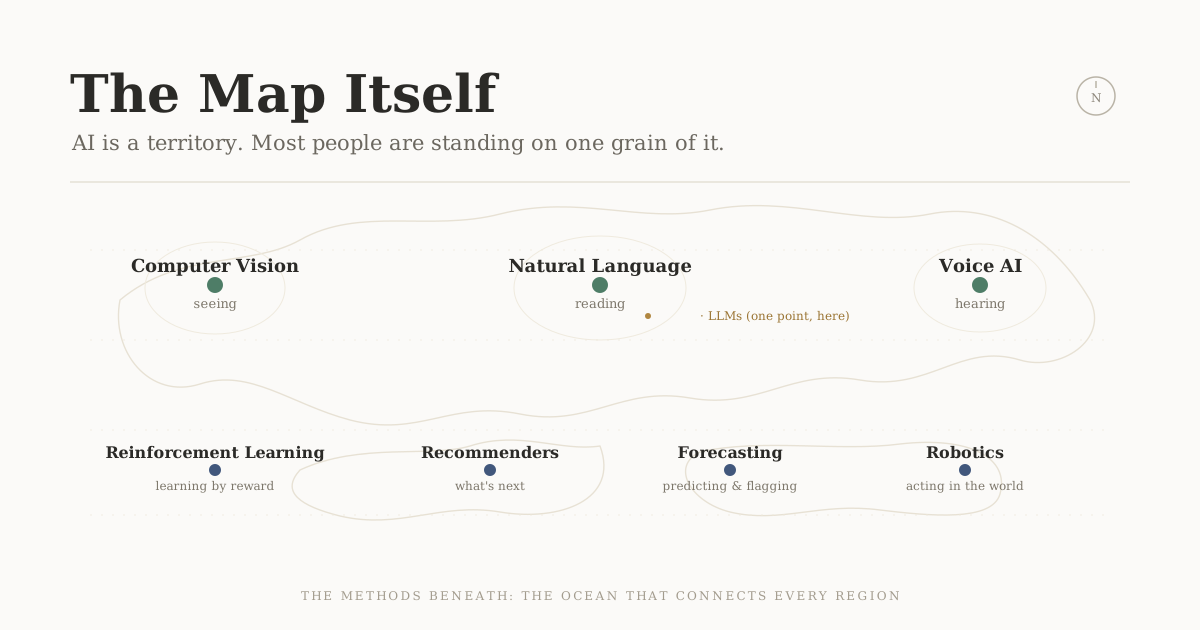
Computer vision is how machines make sense of the visual world, pixels, edges, shapes. Inside it:
- Image classification: deciding what a whole image is. It's how a photos app sorts your pictures into "dogs," "beaches," and "food" without you labelling a thing.
- Object detection: finding and locating specific things within an image. It's how a self-checkout spots the barcode, or a camera draws a box around each face.
- Face recognition: matching a face to an identity. The reason your phone unlocks when you look at it.
- Optical character recognition (OCR): reading text out of an image. Depositing a cheque by photo, or reading a number plate off a car, the question that started all this for me.
- Medical imaging: spotting patterns in scans a human eye might miss. Radiology systems that flag a possible tumour for a doctor to review.
- Motion detection: noticing change across frames. The security camera that only records when something moves.
Natural language processing is how machines work with human language. Inside it:
- Machine translation: converting between languages. The app that reads a foreign menu for you on holiday.
- Sentiment analysis: judging the feeling behind text. How a company reads ten thousand product reviews at once and knows whether people are happy.
- Named entity recognition: pulling structured facts out of messy text, names, dates, amounts. How a system turns an email into a calendar invite.
- Large language models: generating and reasoning over text. ChatGPT, Claude, and the wave everyone's talking about. Worth holding onto this one: as a capability, it's one technique, born inside this one region.
Now, you might reasonably push back here, because ChatGPT clearly isn't just text anymore. Ask it and it generates images, writes code, makes charts. Isn't the LLM behind all of it, the backbone of everything?
Not quite, and the distinction matters. When ChatGPT makes you an image, the language model didn't paint it, it called a separate image-generation model (a different region entirely) and passed your request along. The LLM has become a brilliant conductor: it understands what you want and coordinates the other regions to deliver it. But a conductor is not the orchestra. The fact that it can reach across the map to computer vision, to code, to speech, is not proof that it is the map. It's proof the map is real, and full of other regions worth reaching for. The conductor is impressive precisely because there's a whole orchestra to conduct.
Voice AI is how machines hear and speak. It's less a separate region than a harbour, built where hearing meets language. Inside it:
- Speech recognition (ASR): turning spoken words into text. The dictation that types what you say.
- Text to speech (TTS): turning text into a spoken voice. The navigation app reading directions aloud, or your phone reading a message back to you.
- Voice assistants: the full loop, hearing you, understanding, answering. Siri, Alexa, and the voice systems now handling real phone calls.
Those are the three regions I walked through myself. By the time I'd found my way around them, my "almost done learning" feeling was long gone, but these next ones broke it further still: because computer vision, language, and voice are only the part of the map concerned with perceiving the world. These were the other oceans, the ones I hadn't even known to look for:
- Reinforcement learning: machines that learn by trial and reward. How a self-driving car learns when to brake, and how a system learns to beat a human at a game nobody explicitly taught it.
- Recommender systems: predicting what you'll want next. The quiet engine behind what Netflix queues up and what your music app plays.
- Forecasting and anomaly detection: predicting numbers and catching the ones that don't fit. How a bank flags a fraudulent transaction in the half-second before it clears.
- Robotics: perception, decision, and action joined together in the physical world, a warehouse arm, a drone, a surgical assistant.
Every one of those is a region with its own depth, its own history, its own experts. And this is still only the major cities, each one has its own towns, its own back streets, and if I mapped every one of those this post would be a book. So take this as the overview, not the atlas.
Underneath all of them, though, runs the same deeper machinery: the learning methods that do the actual processing. The same core ideas that let a model read a plate also let it read a sentence, price a risk, or steer a car. The regions are the coastlines you notice. The methods are the ocean underneath, connecting all of them.
That's the map most people never look at. They're standing on one beach, computer vision, or language, or voice, certain it's the whole of AI. It isn't.
And if you came from my last post, where I kept insisting AI is bigger than large language models, now you can see exactly how much bigger. The LLM everyone treats as the whole of AI is one capability, inside NLP, which is one region, on a map with many. Not the map. A grain on one of the beaches.
Which raises the obvious question: if the territory is this big, how did we all end up crowded onto one corner of it?
[Coming next: the eras. There were always more than LLMs on this map, so how did we get here? What was so shiny in AI, era after era, that we couldn't see anything else?]